Translate

Showing posts with label South Korea. Show all posts

Monday, February 24, 2014

Tight-Rope Walks, Farming, and Medieval Punishment: Visit the Korean Folk Village 한국민속촌


HAPPY YEAR OF THE HORSE!

February marks the last month of over two years' posts about living and working in South Korea as Foreign English Teacher. It's been a lot of fun reminiscing and processing all of the beautiful and colorful experiences in and around Seoul, but in honor of St. Patrick's Day, this March The Wanderer Blog will be jetting over to none other than Dublin. Yep, it's time for an Ireland Travel Series. I have an uncle who practically lives over there, and in 2005, I got to see why he fell in love with those rolling green hills during a five month stay. I hope a spotlight on Ireland can bring back many fond memories for those of you who've been there, as well as encourage future travelers.

So although it's time to say goodbye to South Korea for a little while, it will still stay a major presence in this blog, and it is definitely going out with a bang as we visit the Korean Folk Village outside of Suwon, Gyeonggi-do:  

~Winter~


The Minsok village is an immersive walk through the village experience of South Korea during the Joseon Dynasty era. Housing styles varied not only by class--peasant, landowner, or the elite yangban--but also by region. After strolling through the huts common in the northern and central parts of Korea, where various employees can be seen sewing, farming, and making furniture, the complex opens up to the southern style homes found as far away as Jeju Island.  

Check out this cow's day job.


A relative took me out here by car along with her young daughter. It immediately became apparent that her daughter was no stronger to the village, pulling me over to a giant cart horse patiently standing by while tourists gawked and petted it. She also showed me a popular game in both China and Korea during the new year and Chuseok, which was called Tuho. In Tuho, one attempts to throw long slender sticks into a ceramic pot. There were plenty of people enthusiastic to play despite the game's difficulty; I was quickly shown up by the seven-year-old's skill.
I get to work.

Fan of the Korean drama "Dae Jang-geum/대장금" (Translation: "The Great Jang-geum," also known as Jewel in the Palace)? This popular time period show follows the trials and romantic entanglements surrounding Jang-geum, based on the life of the first and only female physician to King Jungjong during the Joseon Dynasty (est. early 16th century). Parts of it were shot here in the folk village. I haven't seen the show myself, which fictionalizes Jang-geum's early career as a chef, but my relative assured me that this scene among the kimchi pots was quite famous. You can learn more about the show here.
After being put to work and discovering how long it takes to pound rice, we were awarded by catching a late show. Interactive performances of namsadang, which consists of such theatrical feats like acrobatics, pungmul nori (spinning hat dance), and salpan (tumbling) reoccur throughout the day, but we'd spent a lot of time exploring the park. We managed to see one of the last shows, the eoreum, or tightrope dancing. I kid you not, it was something like thirty degrees Fahrenheit outside, but once this older performer warmed up to the icy rope, he was unstoppable. 


We rounded out the trip with a visit to my relative's daughter's favorite spot--the ghost house. It does cost a little extra to take the tour, but there's all sorts of spooky fun inside. My relative told me to go through the house with the daughter, since she'd already been through in the past multiple times. It was quite entertaining to see a few other boys lose their cool inside, but my relative's daughter didn't bat an eyelash. I almost wondered if she had fun, she was so quiet during the ghost house walk, but afterwards, she squealed and wanted to go again. 


Sunlight catching off the ice in winter.


Saturday, January 11, 2014

Hiking Jirisan 지리산


JIRISAN NATIONAL PARK (지리산국립공원) is located in the heart of South Korea, spanning across four counties in three different provinces. Along with Seorak San National Park, it was one of my must-sees while teaching in Korea, so I jumped at the chance to do a sunrise hike Friday night after the work week. Who wouldn’t when there was the chance to see one of these endangered fuzzy little guys?

Asiatic Black Bear. Photo Credit: Spencer77, http://www.everystockphoto.com/photo.php?imageId=10552852
Packs of other Foreign English Teachers and Koreans swamped the Seoul Hiking Group bus, about forty of us in all. The drive from Seoul down to Jirisan took about five hours, and we arrived some point at around 2:30 am. We’d ceased seeing other cars a while back, and now it was just our bus in the middle of a thick woodland. We only had a couple of hours before the sun came up, so we hefted our packs, checked our water bottles, and hit the trail.

Our plan was to hike the strenuous East Ridge, which begins at the end of Highway 20 just past Sicheon Myeon (see map). Many among the group were hardcore hikers, who planned to do the entire ridge from Daewonsa to Georim, a distance of 16.8 miles (27km), estimated 10 hours. The bus would pick them up at the other end. For the rest of us, we would take the Chibanmok-Daewonsa Trail up to the ridge to pick out Cheonwangbong, the second highest peak in all of Korea.

This is one of the lushest hikes I’ve been on. Seorak San always made me think of granite, and I saw the same unique rock formations hiking in Jirisan, but overall, it was remarkably cool and shady. Also, the elevation gain was quite gradual; there weren’t too many of the steep ascents Seorak San is known for on this ridge hike.

While any bears remained well-hidden, the overcast temperatures and pleasant company of hikers along the way made this a quiet escape from the city. Anyone planning to do more extensive hiking in the park should check out this website.

The above is depicted as fiction, not fact.

Tuesday, September 17, 2013

Walking along the DMZ 한반도 비무장지대

In 1953, the Korean War ended with an armistice. Not a peace treaty. As such, North and South Korea remain divided at the 38th parallel by a line decided with *much* input from Cold War enemies the Soviet Union and the US--the Demilitarized Zone (DMZ). It spans a length of 160 miles and is approximately 2.5 miles wide of land mines, wilderness, and a surprising number of endangered species. 

Today, the DMZ remains heavily patrolled. Soldiers on both sides watch for suspicious activity, South Korea remembering when they found evidence of the North Korean-dug tunnel in 1990. The 6-Party Talks dedicated to the denuclearization of the Korean Peninsula hang in limbo, the financial realities of an eventual reunion cast hesitation on the South Korean side, and Dennis Rodman continues to be the most frequent American visitor to North Korean dictator Kim Jong-un, wielding the formidable likes of "basketball diplomacy." 

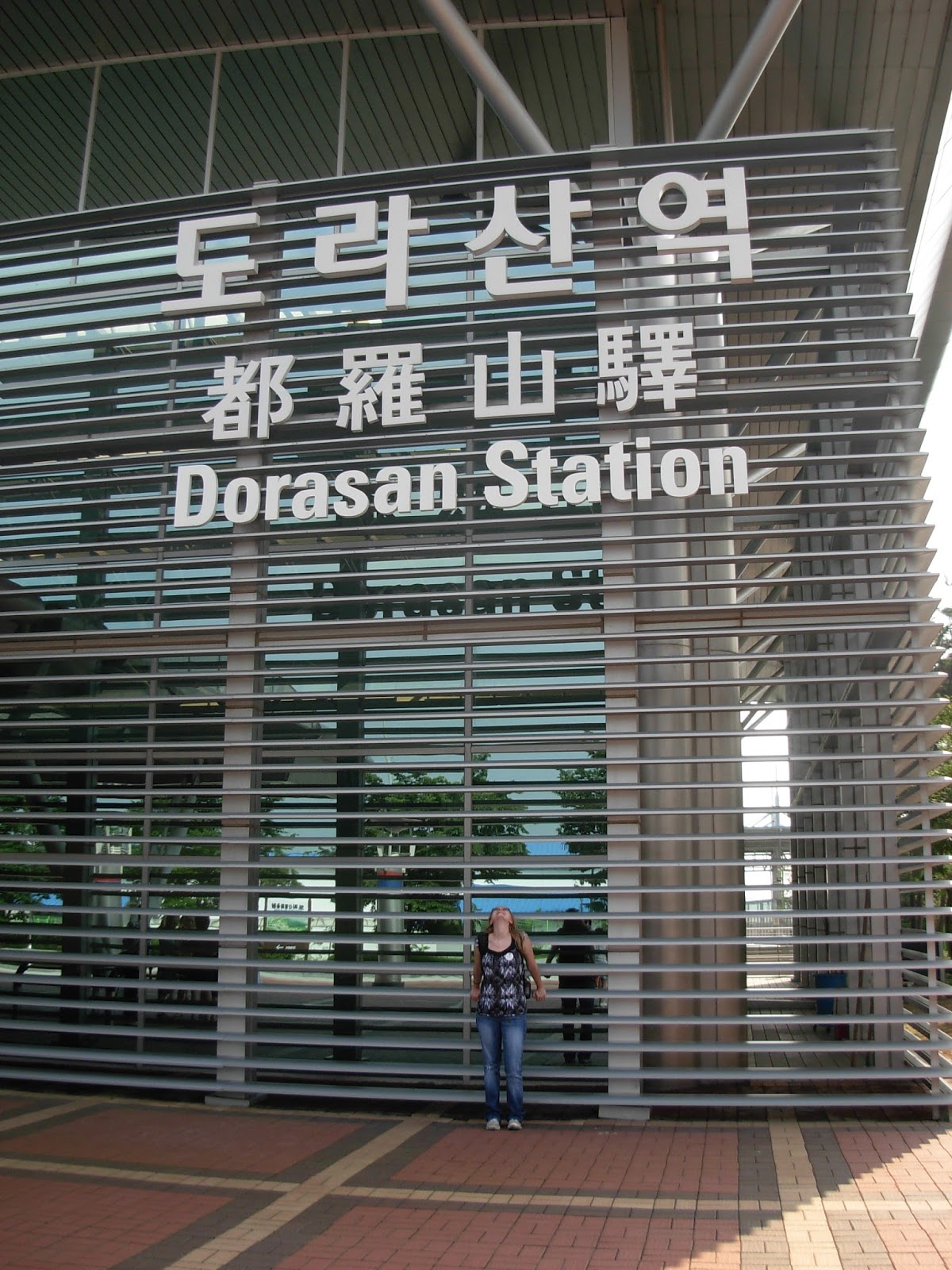
Will  this sign at the northernmost Dorasan Train Station continue to be an empty gesture?


Separated families on either side certainly hope not, and so do the thousands of refugees who flee through China every year, where they must really know who to trust, or else they will be sent back to North Korea due to their "illegal immigrant" status. The current administrations of North and South Korea continue to hold working level talks about co-run ventures. The jointly sponsored Kaesong Industrial Complex, which was nearly shut down over the summer, has recently rebounded and resumed operations on 9-16. The first family reunion in three years is planned for Sept. 25-30th. So the story continues in its up and down pattern, with the US, Japan, China, and Russia watching at every turn the course of two small nations on a very strategically located peninsula. 

Naturally, tourists flock to the infamous DMZ, and I was among them. Normally I do tours with Seoul Hiking Group, which in addition to affordable hiking trips, also offers tours to Jeju Island, Ginseng Festivals, rafting locales, and featured biking excursions, but this time I decided to try out Adventure Korea. They offered a one-day tour of the DMZ for 43,000 won that included a bus pick-up from Hongik University Station (홍대입구역/Hangeul Pronunciation: Hongdae Ipgu Yeok). Identification is *required* to pass the Civilian Control Line, and for foreigners that means a passport or Alien Registration Card.

My fellow Foreign English teacher friends couldn't make it for the August trip, but I made some new friends on the bus ride over, one of whom worked in a hagwon for her aunt, and another who taught in West Seoul. We kicked off the tour by visiting Imjingak, the northernmost village civilians can freely visit before having to provide identification. Our tour guide knew a guy there who sold North Korean money to tourists and was most likely making a nice profit off of it, too, but hey, I was curious. Our guide continued to be full of interesting stories on the ride up to the Civilian Control Line--he remembered fondly the old days when tours were still allowed to enter border villages of North Korea and have a couple drinks with the locals.


At the Civilian Control Line, we registered to cross over into Tongilchon, a Unification Village. Soldiers walked upon and down the bus and examined each of our IDs. Then we were settled in a farmhouse in a rather empty-looking village for a lunch of a miyeok guk (seaweed soup), tangpyeongchae (jelly noodles and veggies), kimchi, and various other side dishes. The South Koreans living in the village inhabit a Tax Free Zone/exempt from 2-year service in the army because of their proximity to the DMZ, but they do have to follow various government regulations when exporting crops over the Line.

From there, we arrived at the cavernous mouth down to the 1978 North Korean-dug infiltration tunnel. Wearing hard hats, we descended deep into the earth and walked past rubber mats and remnant mining equipment before laying eyes on the discovered tunnel, 239 feet under the earth (app. 73 meters). Our guide informed us that it would have allowed some 10,000 soldiers to reach Seoul within one hour.


I ran into some trouble at the next stop, the Dora Observatory. It overlooks the vast expanse of the DMZ, much of it hidden behind cloud cover. Unfortunately, I misunderstood my guide's explanation about where to take pictures and where not to, and a South Korean soldier politely informed me that I was not supposed to photograph Kijongdong, a North Korean propaganda village that features an insanely tall flag pole, built to make sure it overshadowed South Korea's flag. Aside from a couple supply trucks far off in the haze, the green expanse of the DMZ appeared eerily still. I deleted my photographs under the soldier's supervision.

Dora Observatory
 
Aaaand there's your picture of North Korea. Hey, if you squint you can see a mountain. Soldier ok-ed this one.


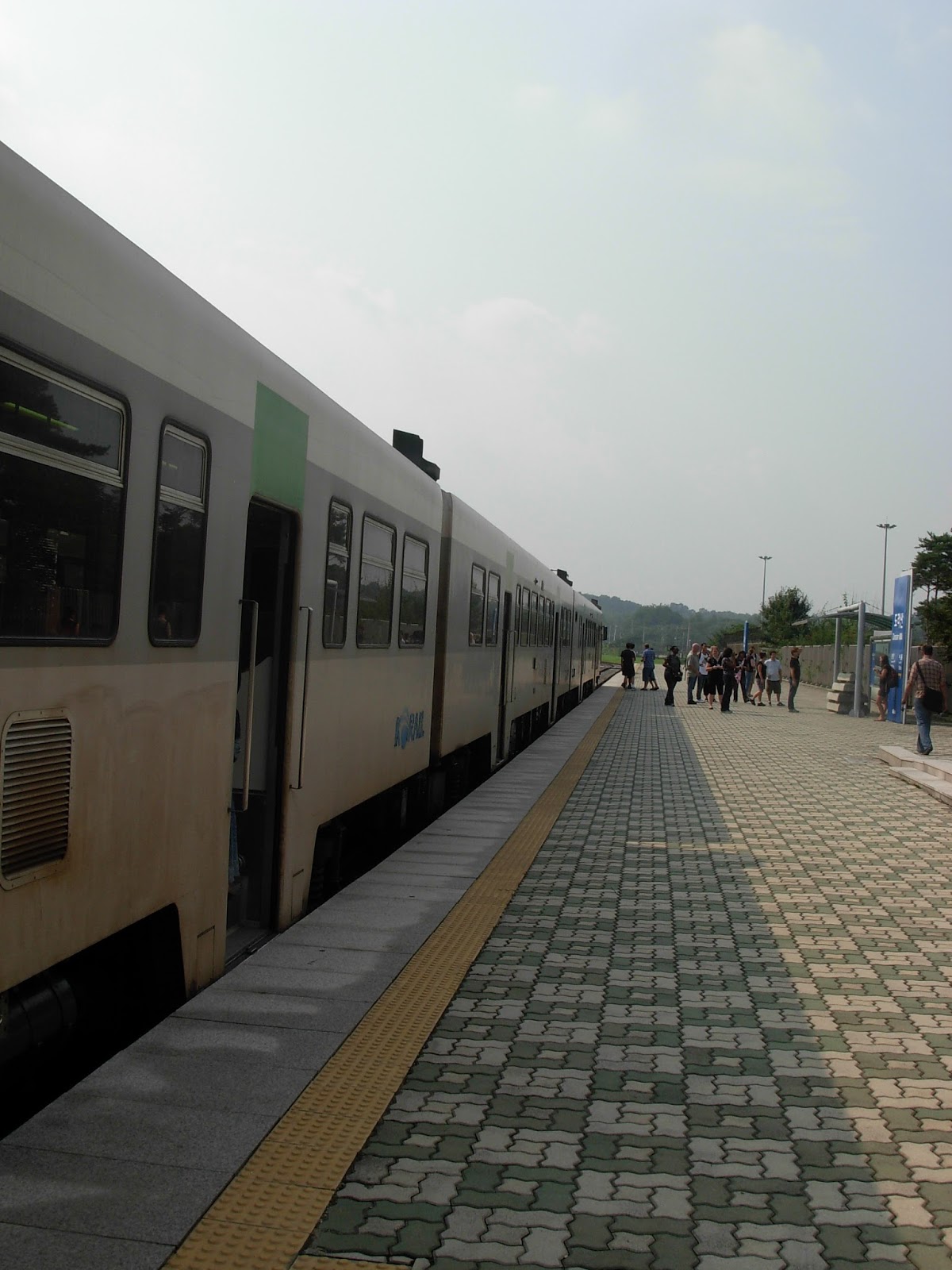
The last stop on the tour was Dorasan Train Station, meant to give some semblance of hope, I suppose, because of its emphasis that one day it would connect back to North Korea. Peoples' spirits lifted while exploring the train station, and the long-suffering soldiers posted around the platform agreed to be photographed with many of us. We could also purchase a symbolic ticket embarked with a seal for about 1,000 won (1 dollar). We goofed around the silent platform for a little bit and then boarded the bus back to Seoul, leaving the empty station with its motionless turnstiles and patiently waiting trains behind.


You know he was bored.


*Disclaimer: The above is depicted as fiction, not fact.


Tuesday, August 20, 2013

Visit Citlalli's Seoul

Curious about the places Citlalli visits in the Changeling Sisters Series? Check out the new page, Worlds Strange and Wondrous, for pictures and a little bit of history behind the South Korean locations.

Saturday, June 22, 2013

Jjimjilbang It! 찜질방에 가자!


KOREAN TEACHERS unfortunately have to work on Saturdays, but if you're a foreign English teacher, you most likely get weekends off! There are probably a number of places you’d like to visit for a quick weekend getaway, but hotel costs have you worried. Or maybe you find yourself out in Seoul for the night, and you don’t really feel like taking an hour-long subway ride home. Jjimjilbangs are the famous Korean bathhouses that offer hot spas, saunas, massages—and even a little mat on which to spend the night. 

Image courtesy of koreagetaround.wordpress.com.

 This is your poolside alternative to motels and hostels. Visits can cost as little as 8,000 to 14,0000 won per night ($8-14), depending on the bathhouse. Inner city jjimjilbang stays may cost more. 

I’ve stayed at a number of different jjimjilbangs in Seoul, North Chungcheong, and Jeju Island (which featured one built over natural hot springs). The main routine is basically the same: at the counter, you will be given your jjimjilbang clothes—usually pink or orange shorts and an overlarge T-shirt—and two locker keys on a bracelet for your shoes and clothes. The first room is where you will deposit your shoes for the duration of your stay. Next you’ll arrive at a main co-ed room, set up with a snack counter, TV, and mats & pillows for sleeping. One of my favorite Seoul jjimjilbangs was built like a multi-level hive with massage chairs, quiet/loud rooms, and sand rooms for stripping the dead skin from your feet.


We arrived in the dead of night, so there was a lot of competition for sleeping space. At the very top floor, we managed to find a cluster of little “dens” built out of wooden blocks that you could climb up ladders to nest in. Surrounded by strangers and suffering from an incredible paranoia of getting my phone jacked (ever since I nearly got pick-pocketed in England many years back), I think it’s safe to say I didn’t sleep well. It was incredibly warm, though.


At other jjimjilbangs, I’ve fallen asleep on massage chairs or mats. It’s generally a pleasant free-for-all with families, couples, or working people spending the night there, and you get to enjoy delicious snacks like sikhye (rice juice) and most awesome of all, patbingsu (shaved ice topped with sweet red beans, kiwi, strawberries, and whip cream).

An amazing patbingsu. Image courtesy of www.thewalrus.com/blogs.

 The next day, we got to explore a bit before checking out. The baths are segregated, so men and women go to their separate locker rooms, strip down, and enter a steamy room filled with hot and cold baths, dry heat saunas, and depending how creative your jjimjilbang is—ice, crystal, sand, or wood rooms. Regular showers are available to use before entering the spa, and most include some combination of mirrors, sinks, blow dryers, soaps, and sometimes even shampoo—but don’t count on it. 


My hat is off to foreigners who go by themselves. Korea is a pretty homogenous place, so your birthday suit will often earn gawks and gossip from the older crowd. However, if you go with a group of friends, it isn’t so bad. Tuck up your hair in Sheep Head, or the “Princess Leia” look (luckily I had a friend along who could show us how to fold the towel!) and relax.

 Image courtesy of Cyworld.com. Link to English translation KpopNews.org.


“Itaewonland” in Itaewon (이태원) is a jjimjilbang famous for where famous actor Hyun Bin (My Name is Kim Sam Soon, The Snow Queen) filmed scenes for the successful K-Drama Secret Garden. You get to take a picture with the cut-out!)

 Image courtesy of http://www.lostintherok.com/.


To find a jjimjilbang, look for the Hangeul characters, 찜질방, or find the sauna symbol of three heat waves, pictured below:

Above, you might recognize "사우나": Sa-oo-na, or Sauna. Image courtesy of www.hobotraveler.com.

Some may be several floors up or down in a building, so look carefully for floor numbers (L1 = Level 1, ect). It’s recommended to travel with someone up to speed on their Korean, as there may be no English speaking services available, and it's also the best way to take full advantage of massage/bathing routines available (like the "thread face shave"! :D). And perhaps don’t go to a jjimjilbang too close to where you live—you never know if you might run into one of your students out with their family for a spa night. 

BONUS MATERIAL

If you’ve read Year of the Wolf, you’ll remember that some foreigners are still working through their bathhouse culture shock. Here’s a snippet of a conversation between Citlalli and Rafael on an important initiation night:


WARNING! Spoilers!


Twilight carpeted the land. Overhanging oak branches blocked what little light was left, so all I could see was the glint of Rafael’s white T-shirt ahead of me and a flash of raggedy jeans. He caught me looking at him and grinned, falling back into step beside me.


“Is that really what you’re going to wear?” he asked, raising an eyebrow as he looked up and down my leather jacket, shimmering silver V-neck, and skinny jeans.


“Well, yeah. I didn’t expect it to be such a hike to get there,” I huffed, dragging my tote bag along. He didn’t make any effort to help me carry it.


“I’m just saying,” he gestured to that white T-shirt hugging his lean, defined muscles. “We wolves go through clothes pretty quickly. It’s not like clothes can change with us. We’ve all seen enough of each other at one point or another—or too much, in Jaehoon’s case.”


I must have looked mortified, because he grinned evilly. “Come on, Citlalli. You’ve lived here for four years? You must have braved the jjimjilbangs at one point or another.”


The jjimjilbangs were Korean public bathhouses, notorious for scrubbing off all that dead, nasty skin until you were left raw and clean and fearful of any ajumma wielding an abrasive sponge. However, there was a strict no bathing suit rule. Mami had made me go once. I’d had to break into the liquor cabinet to summon up the nerve. Everyone was naturally curious about foreigners, and had no qualms, none at all, about staring. I was terrified, absolutely terrified, of public nudity.


I tossed my hair and glanced back at Rafael. “Sure. I have no problem with it.”


—© 2012 Year of the Wolf


Disclaimer: The above is depicted as fiction, not fact.

Friday, May 31, 2013

The Hospital: To Go or not To Go?

Update: 

While I am still out on the sidelines when it comes to physical activity, writing is very much within reach again! I do have this to share about my hospital experience:

We've been conditioned to go to work no matter what. Everything depends upon us being there. To call in at the last minute and say "I can't come in," means someone else has to rearrange their schedule to cover for you, the business will suffer, and a volcano might explode. Maybe two. 

Your coworkers will find a way to survive. You, however, shouldn't overlook what your body is trying to tell you. I am so guilty of this. In South Korea, I tried to convince myself I wasn't coming down sick, even when I could barely speak without coughing, and I ended up in a small hole-in-the-wall clinic strapped up to an IV-bed in a coat closet. Hey, it was a private room. And now recently, when I had sharp lower abdomen pain that kept me up all night, I managed to tell myself that it was indigestion. Maybe I would call in sick. When I started throwing up, okay, maybe it was time to go to urgent care. I could drive myself. Thankfully I called my boyfriend's mother, who told me I was being stupid. 

Ask for help. I had this debate with myself about whether or not to go to the emergency room—the emergency room means steep bills, and lots of them, and really, aren't there people who need the ER's attention more than me? It's good to have such supportive family and friends who dropped everything, because they sensed I probably wouldn't make the smart decision for myself. Especially my boyfriend, who, although starting a brand-new job that day, dashed out of there with barely a word on where he was going. All of that can be straightened out later. Know what can wait and what can't. Struggle against the conditioning. Take a couple weeks off, because even with all the medicine and the incredibly cool new surgical technologies that make recovery time faster than every before, your body is a far cry from Iron Man's.

That brings to me to the second part: Man, do I ever put my characters through the ringer. Here I am, cowed by one medical emergency, while in the Changeling Sisters books, I put my characters through fist fights, stabbings, and worse. I truly am a horrible author to my characters. This will make me re-evaluate how I write fighting sequences in the future. Definitely a reminder to keep the "miraculous recoveries" under wraps. 
So here's to getting better and treating our bodies well! Cheers.  

Earlier:

Hi Everyone,

Unfortunately I'm currently recovering from an unexpected surgery, so I'll be out for a bit. It was successful, so as long as I stick to my mochi-juk-jello diet, I should be fine :) Thanks for the well wishes. 

Best,

Heather