Saturday, February 7, 2026
February 2026 Book Review - Fourth Wing
Fourth Wing
Friday, December 23, 2022
December 2022 Book Review: All Systems Red
*Warning! Minor Spoilers!*
MURDERBOT PROVES INSTANTLY RELATABLE when all it wants to do is watch tv shows. This novella by Martha Wells introduces us to a spacefaring future where the faceless Company is in charge, dispatching droid “SecUnits” like Murderbot to protect missions. Murderbot, who has hacked its governor module and is able to cover its newfound autonomy, immediately uses it to binge all the thousands of sitcoms it can intercept—all while making sure the silly humans mapping a new hostile terrain don’t kill themselves.
It's a quick read that serves as an introduction to a greater series that stays largely in the shadows for this installment. We are teased with greater mysteries lurking, such as why Murderbot dubbed itself such an ominous title, and the crew of humans it protects also stay largely faceless. Our narrator is an android so just the brisk, data-driven facts about the crew at large. There is the head of the exploratory mission, Mensah, who sees the humanity in Murderbot, comical relief like Ratthi, and an interesting augmented human called Gurathin who is less trusting. The team discovers someone is out to sabotage the exploratory missions on this terrain and teams up with Murderbot to save themselves, especially when it appears the Company may be in on it.
Part of the expository style and underwhelming names like “the Company” make All Systems Red feel generic; if this had been published even ten years back its AI storyline grappling with the meaning of humanity and second-class citizenry may have made more of a splash, but compounding with this being a novella, the result is an unremarkable, easy story. Not much is delved into about why Murderbot feels so drawn to the human-written series Sanctuary Moon, for example (387 episodes mentioned!), and its realization at the end is more of an abrupt action to usher in what will likely be deeper questions explored in further works.
Nevertheless, you can’t argue it doesn’t have a unique narrator who pokes fun at our humanity. A nice dive off point for The Murderbot Diaries.
Recommended for fans of: Arkady Martine; Tamsyn Muir; Dennis E. Taylor
Saturday, August 6, 2022
August 2022 Book Review: The Last Story of Mina Lee
The Last Story of Mina Lee
By Nancy Jooyoun Kim
~Book Review~
The writing is easy and introspective, capturing the sense of regret and reflection in both Margot and her mother, Mina, as they ponder what could have been. Mina’s chapters are the most engaging as we watch her evolve from timid to taking a stand, and both perspectives capture how isolated and apart they are, no other family except for each other. Kim builds each chapter’s closing to great effect, such as revealing the tragedy Mina left behind, and she shows how the outcome of North and South Korea’s split impacted families for generations.
Margot is joined in her investigation into her mother’s death by an engaging friend Miguel, and Kim does a great job illustrating the mix of Chicano and Korean cultures interfusing on the LA scene. By and large, food plays a central part, and I’ve never finished a book so hungry—whether it is Mina, reminiscing about the past over a bowl of jjigae, or Margot, digging into the traditional cuisine and realizing how much it reminds her of her mother, the dominant role food plays in bringing people together is excellently portrayed:
“Once the meat had browned, Margot laid pieces on Miguel’s plate, like her mother would’ve done, before serving herself. A heaviness gathered in her chest. She wrapped a bite of warm white rice, soft pork belly, and ssamjang in a red lettuce leaf, still wet, and crammed it into her mouth.” –page 127
Overall, a reflective beach read that will certainly make us all reach out to our loved ones and let them know how much they mean to us. It captures the sentiment perfectly that as you grow, the more you understand the choices your parents made.
Sunday, June 13, 2021
June 2021 Book Review: Children of Blood and Bone
CHILDREN OF BLOOD AND BONE
by Tomi Adeyemi
~Book Review~
*Warning!
Minor Spoilers!*
In the
land of Orïsha, the nobles rule with an iron fist. The only threat to their
power, the maji and their magical gifts, have been eradicated nearly to
extinction. They now live in fear of military raids and are identifiable by
their shock-white hair. Zélie remembers her mother’s power to summon souls. Other
magi could control the tides or fire, but their connection to the magic of the
land is lost now.
Drawing
inspiration from Yoruba mythology, Adeyemi has crafted a tale of
enemies-to-lovers where different class worlds collide. Zélie meets Amari, a
runaway princess who questions the ruthlessness of the nobility, and together
they go on a quest to bring magic back to the land. However, on their tail is
the zealot crown prince Inan, who is determined to bring back his sister Amari and
kill whoever is in her company.
Yes, Children of Blood and Bone has strong The Last Airbender vibes á la Zuko.
Inan and Zélie forge a special dream connection and Inan is forced to face an
unimaginable truth about himself. Their interactions were some of the most
compelling.
There are
glimpses of interesting characters and motivations, but the pacing is a big
issue. Too much exposition made the story feel bloated, and the characters lost
their edges and didn’t feel unique. The mythology wasn’t given enough chance to
shine. The book felt a bit too preoccupied with falling in line with your
standard YA fantasy we see these days—heavily sanitized and tropey, canned to
please an audience who wants a predictable rinse-and-repeat tale about lower
class rising against oppressors to bring magic back to the land. I didn’t feel fully
immersed and teleported by the story; it was too easy to leave.
You know
the saying there are no original story ideas, only original ways to tell the
story? Which is true, because the aforementioned The Last Airbender TV
series does a marvelous job with its wit, development of the characters, and
world-building to feel unique. David Eddings’ Belgariad series
sparkles with charm, and Ursula Le Guin’s Earthsea books are an example
of how slow pacing can work—because the magical system is so utterly absorbing
that it becomes a character in its own right. More contemporarily, there’s Binti,
by Nnedi Okorafor, which is a shorter story, but Okorafor masterfully
demonstrates that you don’t need more words to transport the reader to a world
they don’t want to leave. In Children of Blood and Bone, there are too
many words, and they don’t say enough to bring this world to life.
It’s
tough because Zélie does have spirit, and her relationship with Inan is one of
the best things about the book. This story is often featured on #Diverse
Reads and #Own Voices, but it doesn’t feel like we really get Adeyemi’s
voice (v. looking at the smoother orchestration and presence in works by Zoraida
Córdova, R. F. Kuang, Julie Kagawa). It feels more that the
publishing industry is trying to churn out as many of these derivative versions
of the post-Twilight & The Hunger Games tropes as it can
without giving the authors time to edit and develop their writing to
make something truly memorable. Look no further than the string of similar
titles that makes all of these works blur together—Children of Blood and
Bone, Shadow and Bone, Girls of Paper and Fire, A Court of Frost and Starlight,
Isle of Blood and Stone, Blood and Sand, The Forest of Hands and Teeth—we
could probably fill a page with “Blood” and “Bone” titles alone.
The
series continues in Children of Virtue and Vengeance. Hopefully with the
foundation set, Adeyemi will be able to branch off into new twists and original
voice for her characters.
Recommended
for fans of: Kiersten White, Daniel José Older, Tochi Onyebuchi
Sunday, May 2, 2021
May 2021 Book Review: The Poppy War
THE POPPY WAR
By R.F. Kuang
~Book Review~
*WARNING! CONTAINS SPOILERS!*
IT’S MULAN MEETS NAME OF THE WIND MEETS…HARRY POTTER? Nah, The Poppy War’s heroine Rin has more in common with Jay Kristoff’s Mia from The Nevernight Chronicles or Nona Gray from Mark Lawrence’s Book of the Ancestor series. She’s not an assassin, but Rin is a tough-as-nails overachiever and morally gray decision maker—she doesn’t bat an eyelash over parting with an adorable pig she carries to the mountaintop every day for endurance training, she self-inflicts wounds to stay awake in order to cram for the Empire’s Keju test, and she is so devoted to being the best solider of her class that she gives up her ability to bear children.
In other words, we have a memorable heroine who makes messy and difficult choices! Rin is very much the heart of this story and I was heavily invested in Part I to see what our peasant underdog would do next to survive at Sinegard, the elite military school of the Nikara Empire (a fantasy depiction of China made up of provinces named after the Zodiac and influenced by the Second Sino-Japanese War and the consequences of the opium trade).
Part I of this book is an excellent thrill ride. Against all odds, peasant orphan Fang Runin “Rin” (Mao Zedong influenced) scores high enough on the Empire’s merit test to earn a spot in the elite military school Sinegard, where the best in the Empress’s army are forged to face threats from the Federation of Mugen (Japan influenced) and Hesperia (The West influenced). Rin is a firecracker. While she forges one friendship with the adorable and strategic genius Kitay, she’s largely set against a hostile upper class who despises everything about her from her dark skin down to her impudence to take a spot away from one of their own. Rin largely responds to these threats with her fists, especially tangling with wealthy rival Nezha more than once (and yet, she also can’t help but notice how handsome he is, cuing Zuko reform arch on the horizon!)
Rin is also drawn to the mysterious and powerful Altan, an upper classman who defeats any opponent he faces. He comes from Speer (Taiwan influenced), and is one of the only survivors of the island nation after a horrific explosion, rumored to be tied to the merciless deity known as the Phoenix. More painful still is the Nikara Empire’s hidden role in Speer’s demise. As Rin delves further into her studies, she discovers her own connection to the disturbing powers of the Phoenix and her aptitude for shamanism, which leads the eclectic and humorous Master Jiang to take her under his wing.
Like I said, Part I is a rousing page turner that doesn’t shy away from the consequences of war and establishing Rin as a character who will follow through on her actions no matter the cost. I loved the conversations about strategy and the tests of the academy, as well as her relationship with Master Jiang.
Unfortunately, the book detours in the second half. After developing Sinegard and Rin’s classmates so well in Part I, the story suddenly does an about face after the Federation attacks. Rin is dropped into the middle of war, which could have worked, except she’s assigned to a special Shamanistic branch of the Empress’s service called the Cike. Kuang now has to develop an entirely new set of characters in the Cike, who each have their own magical powers. We’re essentially starting over watching Rin build relationships with each of them—in the middle of a war, which should be when the urgency is at its highest. Instead, this approach to introduce an entirely new set of comrades throws off the pacing and tension, and also leaves the reader confused, not invested, and wondering what’s going on with Nezha, Kitay, and Venka. Rin as well undergoes a facelift of sorts being quite submissive toward her new leader, Altan, as the Phoenix pulls them in different directions and pushes them to answer how far they will go to win the war.
Nevertheless, this is great military fantasy and I’m sure we haven’t seen the last of Rin’s school friends and enemies. The series continues in The Dragon Republic and The Burning God. For more on historical influences behind The Poppy War, check out this great post by Kevin Kaichuang Yang here: https://readbytiffany.com/2020/11/15/everything-you-need-to-know-before-you-read-the-poppy-war-by-r-f-kuang/
Recommended for fans of: Fonda Lee, Alison Goodman, Mark Lawrence, and Jay Kristoff
Sunday, April 11, 2021
April 2021 Book Review: Beasts Made of Night
*WARNING! CONTAINS SPOILERS!*
GUILT. RESENTMENT. SHAME. Our past mistakes can make us sick, and in Taj’s world, actually take the form of sin-beasts, shadowy creatures of nightmare that wage destruction. The city of Kos uses magicians to draw out the sin from the rich and makes the lower class sin-eaters destroy the sin-beasts, imprinting a memory of the sin in their skins.
Taj is the most talented of sin-eaters, who has withstood even the colossal sins that take on the forms of dragons. However, his skills and uncanny ability to connect with the sin-beasts earns royal attention and draws him into a plot to destroy Kos…
The idea at the foundation of Beasts Made of Night is excellent. Taj feels wholly organic, born from the city and does all he can to survive with cocky flair without ever sacrificing his loyalty to the community he’s grown up with. There were quite a few unique characters. With a bit more time and restructuring, this book has potential to be a truly exceptional book.
However, the execution fails it. The idea of “sin” manifesting as guilt that can make a person physically ill is so fascinating, but it’s never explored. For example, what is considered a sin in this world? There is a passing reference of a council that defines morality, but it is never articulated. If “sin” only comes from feeling guilty, then why the heck are so many of the rich upper class the ones with the most extravagant sin-beasts? Are they shaving their guilt over decisions they make for the city, and if so, why don’t we see more of that awareness battling within them? What about people who are sociopathic or psychopathic and don’t feel guilty about committing actions like murder? Is sin even the best word to describe what’s going on with these beasts?
While I was trying to figure this out, the story moved along at a lurching pace that just couldn’t find its plot. There were a couple key relationships that really stood out: Taj’s relationship with Bo, who is his lifelong friend and fellow sin-eater, and surprisingly, a meeting halfway through the story with the mysterious Zainab, an experienced sin-eater with a spider tattoo on her face. Honestly, I felt that in that meeting between Taj and Zainab, that’s where the story should have started. There was incredible potential there with the pitying look she gave him and her no-nonsense approach to training that could have organized the story in a more coherent way.
However, that’s a bit of the issue with this novel—there are many ideas circulating and too many characters, and the result is a discordant plot. If it was just a focus on these characters + Azru (loved the scene with the peppers!) and Aliya, who also had unique relationships with Taj, that would have been enough to unpack right there.
As it is, the book ends in a confusing battle, and although I wasn’t surprised by the “true” villain—can’t trust those overly sweet characters!—the impact fell flat since there hadn’t been any time spent on developing the villain’s motivations on a more complex level.
All in all, really excited to see what this author does in the future. The imagination and characters are fierce, but there needs to be more fine tuning in the execution.
Sunday, March 7, 2021
March 2021 Book Review: Gods of Jade and Shadow
ONE OF THE MOST INTRIGUING UNDERWORLDS is Xibalba, the Place of Fear (or Place of Astonishment), that holds a memorable place in Maya mythology. Ruled by the death gods Hun-Kamé and his brother Vucub-Kamé (older translations can be Hun-Camé and Vucub-Kamé), Xibalba promises the most tribulations and tricks a soul can find oneself up against, what with a treacherous Black Road, frightful Houses full of jaguars, bats, and flying blades, and a ballcourt where the losing team pays with their lives. It is evocative of the struggles of life amongst teeming jungles of biodiversity, but it has a softer side, too, as Moreno-Garcia explores in Gods of Jade and Shadow.
Set in the Jazz Age, the story begins with a Cinderella flair of sorts with Casiopea Tun stuck serving the whims of her grandfather’s demanding family in a small town in southern Mexico. While dreaming of a life far from this one, Casiopea finds a mysterious box in her grandfather’s house and unwittingly releases Hun-Kamé, deposed ruler of Xibalba. Turns out that Casiopea’s grandfather threw in with Hun-Kamé’s ambitious brother Vucub-Kamé to overthrow the death god and scatter his body parts so he could never return. Undaunted to find himself in the age of flappers and cabaret, Hun-Kamé wastes no time enlisting Casiopea to help him recover his missing body parts so he may retake his place on the Jade Palace throne. However, Vucub-Kamé is alerted to his brother’s release and enlists Casiopea’s loathsome cousin Martin to stop them.
Hands down, the most exhilarating part of the story is at the end when Casiopea competes against Martin to travel Xibalba’s Black Road and reach the World Tree first. Also, any part that features Xibalba. The writing style is lyrical but tells instead of shows, making it difficult to connect with any of the characters. The characters felt like they had no heart, and it was hard to tell Hun-Kamé’s voice/character apart from his brother (as opposed to the wonderful drawn rivalry of say, Mufasa and Scar in The Lion King). Indeed, there wasn’t much justification for why Vucub-Kamé should be overthrown—had the underworld eroded under his care? Was he oppressing his demon subjects or being more horrific to souls than usual? It’s not explored which brother would be the better ruler aside from birthright. Why did Vucub-Kamé want to get rid of Hun-Kamé aside from his own ambition? That’s the level we’re missing to really understand the heart of their relationship.
The plot doesn’t help, as it follows a simplistic formula of 1) collect this body part from forgettable demon minion A, and 2) repeat for demons B – C. There wasn’t much of a struggle or tension built up in any of these face-offs. The Jazz Age’s influence was told to us rather than flowing as a natural part of the story, and Martin is about as formidable as an old sock.
However, Hun-Kamé and Casiopea’s slow burn romance is sweet, and Casiopea refreshingly has plenty of spunk and agency. She doesn’t take sh*t and isn’t afraid to speak up in the overtly patriarchal world. The story wraps up in a satisfying conclusion, but the biggest drawback is the woodenness of the characters and the lack of heart, as we constantly feel like we’re being kept at arm’s length from any raw emotion. Granted, this is tough when writing “distant” god-like characters. Overall, Moreno-Garcia has spun a classic tale that expertly balances both the fear and beauty of Xibalba.
Recommended for fans of: N.K. Jemisin, Rick Riordan, and Aliette de Bodard
Sunday, February 7, 2021
February 2021 Book Review: Trail of Lightning
TRAIL OF LIGHTNING
By Rebecca Roanhorse
~Book Review~
*WARNING! CONTAINS SPOILERS!*
YOU MEAN TO TELL ME that a cataclysmic flood destroys the world as we know it, leading to the rebirth of the Navajo Nation in a mysterious and dangerous Sixth World where gods and monsters reclaim the earth? I am totally here for this. The tension is real!
On the world-building front, Roanhorse knocks it out of the park. The descriptions of the desert, the mesas, the forests of ponderosa and blue spruce carpeting lonely peaks, are all utterly gorgeous, and there is a constant air of menace as ghosts and children-eating monsters roam the hills. Descendants of clans inherit specific magical powers to help them survive their gritty and post-apocalyptic reality, and we get a wise-cracking Coyote who has an invested interest in our heroine Maggie Hoskie.
However, the plot quickly splits into too many threads as the book struggles with what it wants to be. What seems to be a promising monster slaying adventure/mystery gets derailed by an unnecessary love triangle that overtakes the initial premise. Someone is behind the release of increasingly dangerous monsters upon Dinétah, and loner monster slayer Maggie Hoskie teams up with medicine man Kai to investigate.
A common complaint I’ve had of late is the main character proves to be the least engaging, and Trail of Lightning continues my frustrations. Initially I liked Maggie Hoskie, Dinétah monster hunter with lineage gifts of supernatural speed and bloodlust. Despite being quite humorless, she kicked ass, and I was sucked in by the promise of a dark and tangled relationship with her former mysterious mentor, Neizgháni.
Here’s where the issue came in: this book seemed like it should have started with her training and adventures with Neizgháni. The flashbacks with him take up such a significant part of the book that it begs the question why this wasn’t the original storyline in the first place. The consequence is we keep being told about this deep connection they had, as well as how betrayed she feels by him, that we’re dying to have the two reunite already (Never mind what’s happening with Maggie and present day traveling companion Kai). The former mentor-student reunion doesn’t happen until the last quarter of the book, and when it does, it’s in this weird stand-off in a monster dueling ring where he kisses her out of the blue. It feels quite out of left field for someone who had been so carefully guarded about his emotions before.
It also leads to the book taking an abrupt turn toward romance and resolving the love triangle between Maggie, Neizgháni, and good guy healer Kai. This felt like such a departure from Maggie’s character to suddenly be so held up by boyz, and it left the end of the book feeling messy, as if it wasn’t quite sure what it wanted to be.
It would have been interesting for Neizgháni to have joined Maggie and Kai at the start of their investigation into the monsters, and keep these three as the focal point to really flesh out their relationships. Instead, the plot gets constantly distracted by side quests that we don’t really care about, and at the end, it’s a bit confusing when the main quest gets addressed almost as if by accident. I didn’t buy the villain’s true goal; it seemed a very complicated way to get what he wanted.
This book is still easy to get lost in, and although the urban fantasy aspects and romance’s fight to take over the driver’s seat distracted the plot, I am still excited to see where Roanhorse goes in future installments of The Sixth World series, such as Storm of Locusts.
Recommended for fans of: Patricia Briggs, Ilona Andrews, Karsten Knight, and Tony Hillerman
Saturday, January 23, 2021
January 2021 Book Review: Labyrinth Lost
*WARNING! CONTAINS SPOILERS!*
THERE’S NOTHING IN A YOUNG WITCH’S LIFE like making your entire family disappear on your Deathday. Alex is a Bruja waiting to inherit her powers, but unlike her sisters (psychic Rose and healer Lula), she would rather not have anything to do with magic. After her attempt to rid herself of her powers during her Deathday goes wrong, banishing her family to the underworld of Los Lagos, Alex teams up with a mysterious Brujo named Nova and her best friend Rishi to save them from the power-hungry Devourer.
I’ve been on an underworld kick and can’t get enough! Los Lagos proves to be no exception, full of perils like a lost soul river, misunderstood harpies, and everlasting festivities with fairy folk in a seemingly cheerful meadow. It’s easy to get immersed in Córdova’s writing, which neatly balances plot with world-building and has an easy, straightforward style.
The most intriguing character by far is Nova. He’s the bad boy archetype who actually executes on it, and displays genuine remorse after. He felt the most fleshed-out and sympathetic to get invested in. Rishi was interesting as well, incredibly loyal and brave to pursue Alex into the underworld without magic powers. As is a common trend in YA novels, our main character Alex proves to be the weakest of the three. Suffering from insecurity, awkward dialogue, and a brooding, harsh personality, she’s difficult to warm up to, and indeed, the biggest mystery was why both Nova and Rishi would be so into her. It’s difficult to make the reluctant heroine character work when the audience is here for the magic and thrill of having supernatural powers, and Alex comes up short in this regard.
But it matters not! We have a great supporting group of characters including the spirited Lula, cynical harpies, and the mysterious world of Los Lagos itself. The Devourer is a bit one-dimensional but it’s nevertheless interesting to learn the backstory behind her desire to reshape the underworld in her image. Best of all, the other two books in Brooklyn Brujas (Bruja Born and Wayward Witch) focus on the more engaging characters of Lula and Rose, as well as include appearances by the enigmatic Nova.
Overall, this book is fun and all about Alex defining her place in her family, both blood born and made. Latinix influences (Alex is of Ecuadorian and Puerto Rican background) intermix with modern day Brooklyn to create an atmosphere brimming with magic and mystery, where Deos walk among skyscrapers and the spirit world is just a spell’s cast away.
Recommended for fans of: Daniel José Older, Silvia Moreno-Garcia, and Sarah Fine
Tuesday, December 29, 2020
December 2020 Book Review: The Star-Touched Queen
IMMERSE YOURSELF in a retelling of classic love-lost romance that is lush, atmospheric, and driven by mystery. Drawing from Hindu mythology such as the tale of Savitri and Satyavan, and Shiva and Parvati, Chokshi weaves an underworld adventure that takes you to a throne room woven of stars, down passages filled with doors whispering about secrets of the past, and into the heart of self-discovery.
Chokshi writes with vivid purple prose that flares into the over-dramatic at times, but at others it strikes just the right chord to illuminate heroine Maya’s struggles with self-worth. She is a princess, but despite being the son of the raja, her life is bleak due to being born under a dark horoscope that partners her with Death. The courtiers and the raja’s wives blame her for every misfortune.
On her wedding day, Maya chooses a mysterious suitor Amar who promises her a kingdom with magic and power beyond her wildest dreams, who swears that if she becomes his queen, she will be an equal in all decisions. However, it is in a land beyond the strange Night Bazar where wishes can be granted for your voice or first child, in a place entirely otherworldly. In this kingdom called Akaran, Maya must learn the inner workings of a beautiful tapestry that contains all the life threads of every being to preserve balance between realms. But a mysterious woman haunts Maya, warning that her new husband is really her captor.
I enjoyed this book and found it difficult to put down. I found the mystery of Akaran and Maya and Amar’s past lives to be riveting, and I really wanted to know what the deal was between them and Nritti. This was quite a feat, since the characters of Maya and Amar are underdeveloped. Maya is self-loathing and makes many questionable decisions, including trusting Nritti (in both present and former lives when she has full knowledge of her motivations). The best scene is when Maya confronts her father in the underworld about their tragic relationship. Amar is a cardboard personality who I could never quite get a sense of, and the romance is vanilla. I thought it would have been an interesting twist if Nritti ended up being the “dark side” of Maya, or if Amar did have ill intentions, which would have spiced things up and given the main characters not only flaws but agency to act upon them.
However, the story works despite the lackluster leads since the world itself is a character in its own right, and I loved the little details like the elephant who knits clouds and the flesh-eating demon horse. I was hoping the makara (sea dragon) would show up—but maybe that is in the next book.
Speaking of which, Maya’s younger sister Gauri did have a great spark. While this book is a standalone, Chokshi’s second novel in this world, A Crown of Wishes, follows her and a boy Maya sees possible futures for.
Overall, Chokshi’s signature style is like an unfurling love letter, dreamy and full of little currents that delight, and you can expect to be fully submerged in worlds far beyond this one.
Recommended for fans of: Maggie Stiefvater, Renée Ahdieh, Laini Taylor, and Sarah J. Maas
Sunday, July 26, 2020
July 2020 Book Review: Welcome to Night Vale
Monday, June 1, 2020
June 2020 Book Review: Into the Magic Shop

Sunday, March 15, 2020
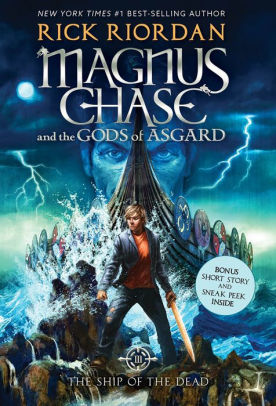
March 2020 Book Review: The Ship of the Dead
MY MOTHER introduced me to Norse mythology early through opera. It was an uphill battle for her to find someone willing to go to an opera in our family, as our first question was inevitability, “How long is it?” I was intrigued by the drama and memorable arias of Georges Bizet’s “Carmen,” and so she lured me to the boss level: Richard Wagner's “The Ring Cycle.” She knew that I was a fan of The Lord of Rings, and so it proved an easy sell to young me, since anything involving devious deities and magic rings held my interest.
Norse tales didn’t entrance younger me quite as much as Greek, Maya, Navajo, and Egyptian mythos, and the 17 hour total of Wagner’s Ring Cycle broke me—that’s not counting trying to escape from the parking garage. Through the years, I’ve circled back to it, wanting to fall in love with the Nine Worlds, ice giants, and the doomsday serpent Jörmungandr. It might have taken Chris Hemsworth and Tom Hiddleston to play Thor and Loki in the Marvel interpretation, but now I am here for it. It has been a delight uncovering layer after layer of legend wreathed with tragedy, betrayal, and hubris. Maybe I’m ready to give “The Ring Cycle” another shot.
Most recently, I finished Rick Riordan’s Gods of Asgard trilogy, and it’s a comedic treat. I really loved Magnus, but Alex Fierro is one of the most memorable characters I’ve encountered in quite some time. This series is probably my favorite since the original Percy Jackson and the Olympians. I actually feel like the second installment The Hammer of Thor was the strongest in terms of instilling the tension and threat of Loki, who is set on starting Ragnarök, the great battle to end life as we know it, but The Ship of the Dead proved a satisfying finale while leaving the door open just a little for when we might see our heroes again.
Magnus is the son of Frey, God of Summer, and that has been an enjoyable path to focus on a hero who isn’t the best fighter and is more the healing-regeneration type. He has two fabulous friends to help on the battlefront: the shapeshifting half-siblings Alex and Samirah “Sam” al-Abbas, children of Loki. Rounding out their crew are the lovable dwarf Blitzen and my personal favorite, the elf Hearthstone.
The book may have been stronger if it kept focused on the core group. We also do have Thomas Jefferson Jr. and Mallory Keen who join them on a nautical journey to stop Loki from launching the doomsday Ship of the Dead (created out of fingernails, there’s an image for ya). As much as I enjoyed hearing about their backstories, and Mallory’s emotional response when confronted with her Norse parent was particularly well done, it did inflate the book and was a bit lost under everything else that was happening: wolf fights, tangles with underseas giants, Hearthstone facing his father, and a plethora of other quests. Add on top of that new Norse characters and deities making an appearance, and it was difficult to keep track of everyone. Loki’s menace felt a bit deflated with everything else going on, as by the time the heroes face the famous trickster again, I felt a bit out of breath—these kids got fortitude!
However, I loved that “flyting” was the key to Loki’s downfall. Early on, Magnus trains with demigod celebs Percy Jackson and Annabelle Chase with the blade, but he’s not the best. Flyting stayed consistent with Magnus’s character and let the rest of his crew showcase their strengths.
The relationships were rock solid. Sam and Amir stay true to each other and are utterly adorable. I like that Amir is the normal guy but supports Sam how he can. I liked Sam’s arch of balancing her dual heritage as she navigates incorporating practices of her Islamic faith like Ramadan with a Valkyrie save-the-world quest. I’ve always loved Magnus and Alex. They are utterly fascinated with each other, and little by little, they push and pull on one another, and ultimately can’t think of anyone else they’d rather be with. Magnus comes to know when Alex, who is genderfluid, is identifying as a boy or a girl, and Alex comes to trust Magnus after a hard and difficult life. Their interactions were the most captivating.
As such, Ship of the Dead is written in Riordan’s signature style of irreverent, edge-of-your seat, nonstop action mission after mission—perhaps too many—but the emotional depth was there in the finale. I’m excited for what Rick will do next.
Recommended for fans of: J.K. Rowling, Christopher Paolini, Roshani Chokshi
Saturday, January 6, 2018
January 2018 Book Review: The Cursed Child
THE CURSED CHILD
By J. K. Rowling, Jack Thorne, and John Tiffany
~Book Review~
Saturday, December 2, 2017
December 2017 Book Review: Glimmerglass
GLIMMERGLASS
By Jenna Black
~Book Review~
Wednesday, November 8, 2017
November 2017 Book Review: Nightshade
NIGHTSHADE
By Andrea Cremer
~Book Review~
Sunday, October 1, 2017
October 2017 Book Review: The Girl in the Steel Corset
The Girl in the Steel Corset
By Kate Locke
~Book Review~
Monday, September 4, 2017
September 2017 Book Review: The Grimm Legacy
The Grimm Legacy
By Polly Shulman
~Book Review~
Monday, July 31, 2017
August 2017 Book Review: Antigoddess
Antigoddess
By Kendare Blake
~Book Review~